
Desktop interface · USB audio interface
eBox-44
eBox-44 is a compact USB interface built around four RCA inputs and outputs. Its inputs switch between phono and line level, with a ground post for turntables, while a microphone input and headphone output support recording and monitoring.
Manuals, downloads & support ↓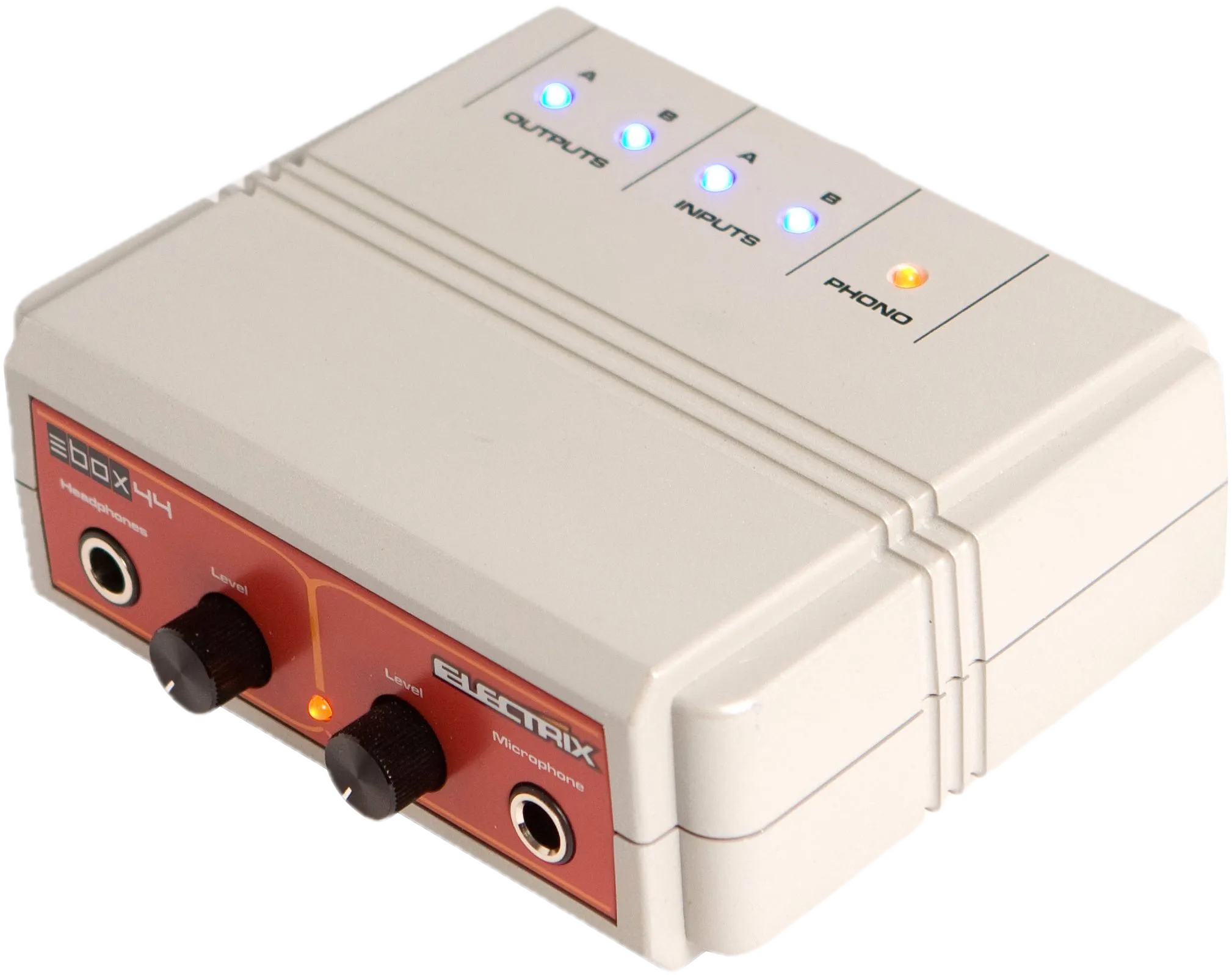
Key features
- Four RCA inputs and four RCA outputs
- Switchable phono/line input stage with turntable ground post
- ¼-inch microphone input with gain control
- Headphone output and direct input monitoring
- USB bus power
- Input and output activity indicators
Technical specifications
- Audio format
- 16-bit at 44.1 or 48 kHz
- Computer I/O
- USB; four inputs and four outputs
- Analog I/O
- 4 RCA inputs, 4 RCA outputs, ¼-inch microphone input and headphone output
- Power
- USB 5 V / 500 mA
- Dimensions
- 118.9 × 125 × 46.5 mm (W × D × H)
- Weight
- 385 g
Connections and controls
- Inputs 1–4: RCA, switchable together between line and phono level, with built-in phono preamps and a turntable ground post.
- Outputs 1–4: RCA, with routing set in the connected audio software.
- Microphone: ¼-inch input with independent gain control.
- Monitoring: ¼-inch headphone output with level control, plus signal-present LEDs on all inputs and outputs.
- USB: audio data and 5 V / 500 mA bus power.
Audio specifications
Line outputs
2 Vrms (+1/−0.5 dB) into 47 kΩ; ≤0.01% THD; 20 Hz–20 kHz ±1 dB; better than 93 dB signal-to-noise and 90 dB channel separation.
Headphone output
1.7 Vrms ±1 dB (85 mW per channel) into 32 Ω; ≤0.01% THD; 20 Hz–20 kHz ±1 dB; better than 90 dB signal-to-noise.
Line inputs
10–50 kΩ, −14 dBV sensitivity; 20 Hz–20 kHz ±2 dB; ≤0.025% THD+N; better than 80 dB signal-to-noise.
Phono inputs
47 kΩ / 100 pF, −54 dBV sensitivity; 20 Hz–20 kHz ±2 dB; ≤0.1% THD+N; better than 78 dB signal-to-noise.
Microphone input
2.2 kΩ, −54 dBV sensitivity; 20 Hz–20 kHz ±2 dB; ≤0.1% THD+N; better than 80 dB signal-to-noise.
Product support
eBox-44 manuals, downloads and help
Original manuals and the final archived driver releases, kept together with the compatibility warning that matters before installation. No registration or email address is required.
Documentation
Drivers
These are the final drivers Electrix shipped. They predate current operating systems — see the FAQ before installing on a modern machine.